Processing claims. In 20 minutes instead of 8 hours.
3
Lines of business live
domestic and international in production
20 Min
instead of 8 h
from receipt at the insurer to the settlement result
Audit-Trail
per matter
every step documented, exportable
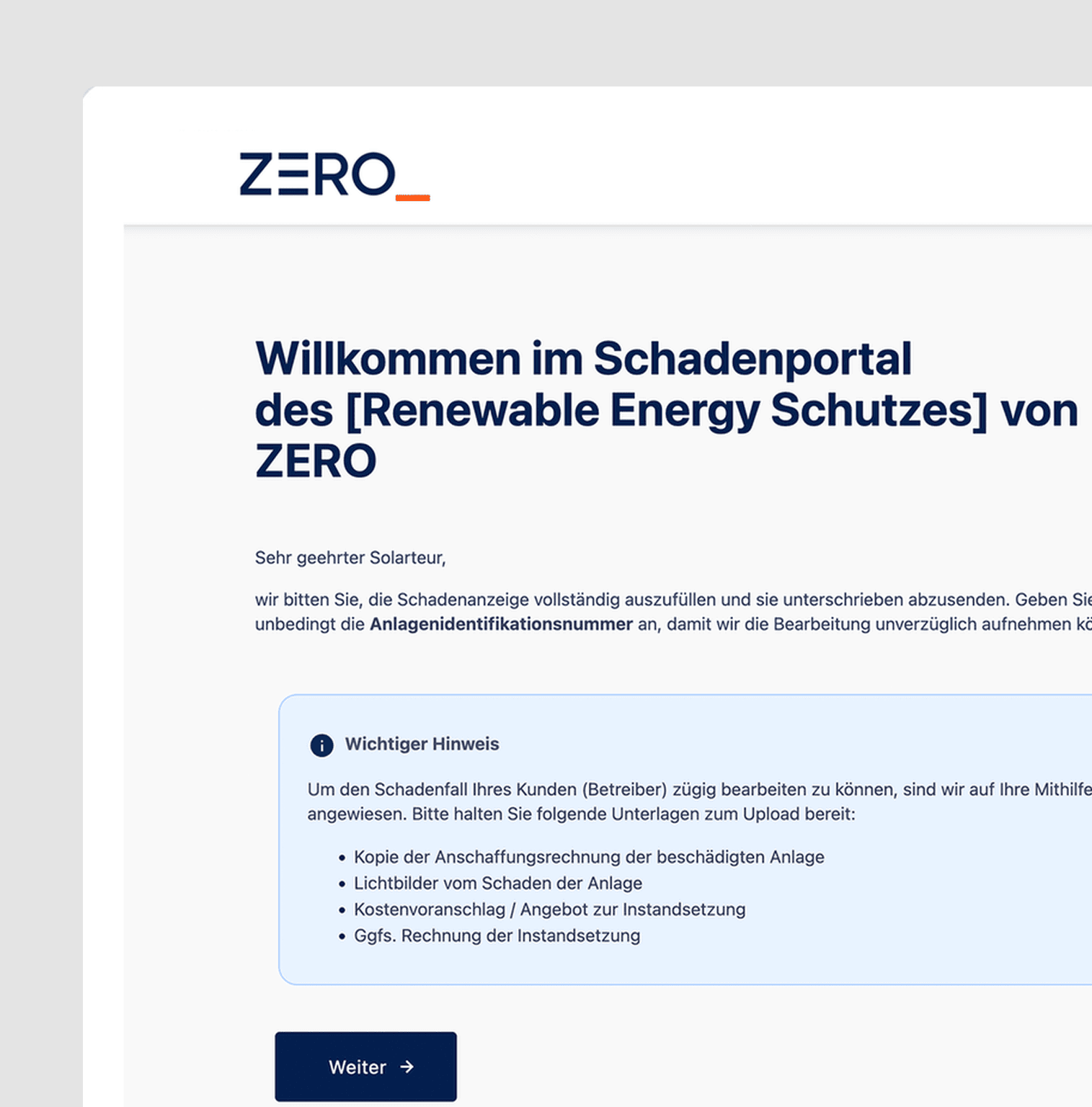
In use
Work. Done.
Product
Zero Insurance uses UNOY as UNOY Claims Engine.
UNOY Claims Engine is the product suite for high-volume matters as a controlled pipeline. At Zero Insurance in self-mode: an insurtech processes claims in 20 minutes instead of 8 hours, with structured intake, assessment, and handover to the insurer.
In use
- Claims processing pipeline
- Data receipt from the insurer
- Assessment + settlement result
- Secure data transfer
- 20 min instead of 8 h per matter
Model & key figures
- Self · Insurtech builds independently
- 20 min instead of 8 h
- Secure data transfer
Who is Zero Insurance?
Zero Insurance
Zero Insurance is an insurtech for claims processing: it handles claims on behalf of insurers, from file handover to settlement result. Three lines of business are currently in production, domestic and international.
What sets Zero apart from traditional claims handling: data arrives from the insurer, UNOY OS processes it in a structured way, and the settlement result is returned to the insurer. No claims handler reads the report manually; they only review critical matters.
The business model depends on processing being fast, scalable and traceable. Zero therefore built the core process not as internal software, but as a platform workflow on UNOY OS.
The challenge
What was difficult before.
Traditional claims processing is linear and staff-intensive: every report is read by a claims handler, documents are requested, data is transferred into the insurance system, the file is created. As case volumes grow, so do processing times, or headcount.
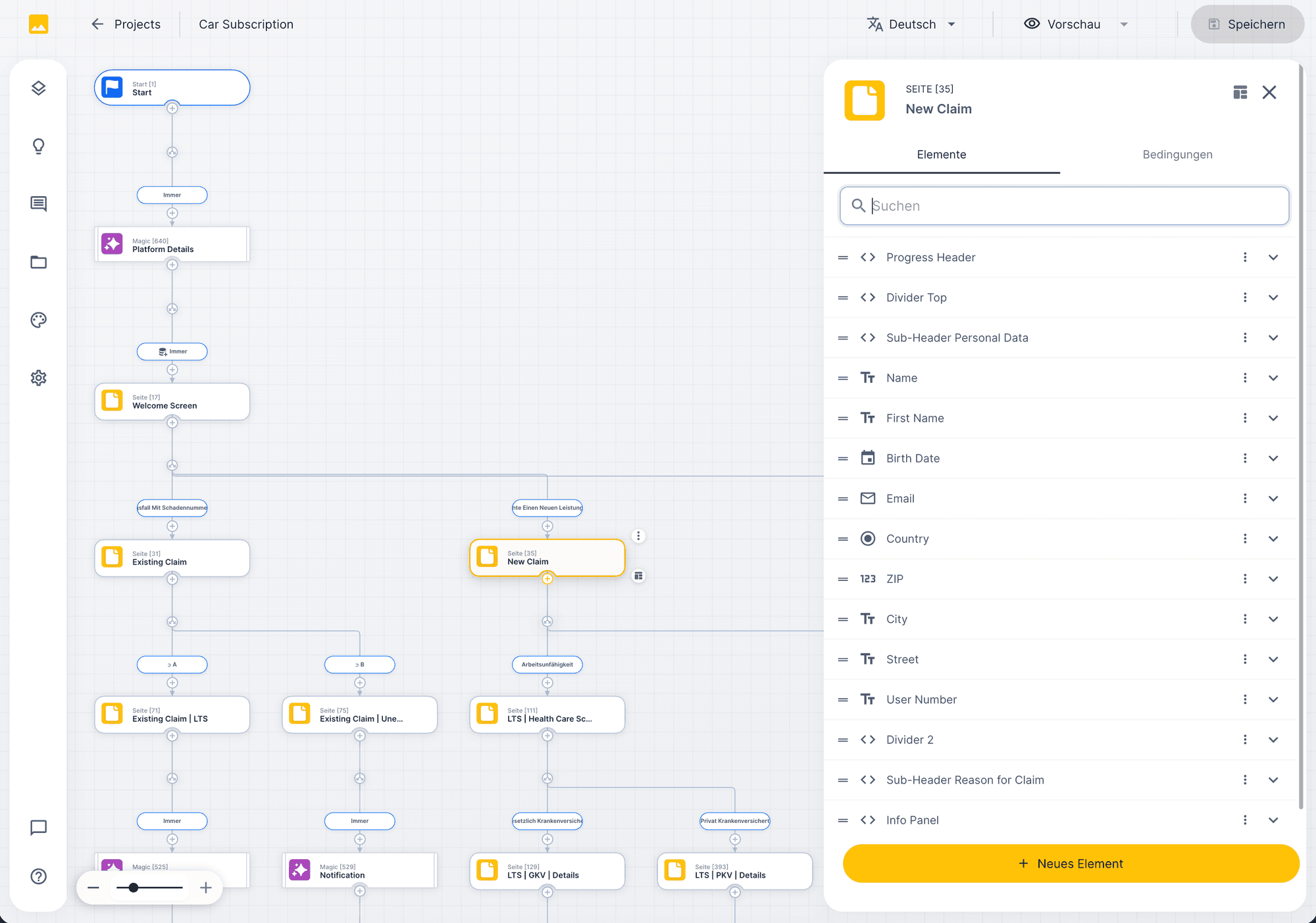
Zero Insurance wanted to do this differently: a claim comes in, a workflow runs. Missing documents are requested rule-based. Structured data is extracted. The file is created in the insurance system. Claims handlers review only critical matters.
The challenge: the result must be correct under insurance law. Not „approximately right“ as with a chatbot. But algorithmically traceable, with audit trail, with escalation in cases of uncertainty.
Voice
Why Zero relies on UNOY OS.
With UNOY we have taken claims processing to a new level. Routine runs rule-based, data arrives cleanly structured at the insurer.
In use · Self-Mode
Zero Insurance handles
Claims settlement as own service · Line-of-business rulebooks and claims handlers in-house
UNOY OS as delivery infrastructure
No-code workflow + line-of-business engine + API + audit trail
Insurer as client
Data in via secure data transfer · settlement result returned
Application
From insurer intake to settlement handover.
Three steps. Claim from the insurer in, assessed, settlement result returned.
Receipt
Receive data from the insurer.
01 · Receipt
The claim arrives at Zero from the insurer via email, secured API or encrypted data transfer. UNOY OS extracts structured data: date, location, type of loss, parties involved, matter reference number of the insurer.
Assessment
Claim checked against line-of-business rulebook.
02 · Assessment
UNOY OS checks against the line-of-business rulebook: completeness, insured event yes/no, loss amount, regulatory requirements. When clear-cut, the assessment runs through. When uncertain or disputed, the file goes to the claims handler with a rationale.
Routing Logic
Clear-cut case: Assessment runs through · Borderline (incomplete, facts disputed): Escalation to claims handler with rationale · No match: Stop, query back to the insurer.
Handover
Settlement result to the insurer.
03 · Handover
Structured data is handed back to the insurer: settlement recommendation, complete file with all attachments, audit trail with every step. The insurer makes the final decision on the payout, on a fully prepared basis.
Learnings
What we learned.
Zero Insurance was the first insurer to deploy UNOY for the complete claims processing workflow in production. What we learned together:
Insurers do not want "90% accuracy." They want 100% traceability. The system does not make the payout itself, it prepares. Claims handlers approve where it is critical. UNOY OS structures the rest.
Each line of business has its own rulebooks and completeness criteria. The infrastructure must map this in a multi-tenant way, each line of business with its own workflow on a shared technical foundation.
Frequently asked
What you want to know.
Who decides on the payout?
The claims handler at Zero Insurance. UNOY OS prepares the file, checks completeness, and structures the data. The insurance decision is made by the person, on the basis of a fully prepared file.
How secure is policyholder data?
EU data residency in data centres certified to ISO 27001, SOC 2 Type II and ISO/IEC 42001 (AI Management), multi-tenant isolated per line of business. Insurance-specific compliance (BaFin/FMA) is built in. Audit trail per matter exportable.
Which lines of business are in production?
Three lines of business in production, domestic and international. We discuss specific lines individually; for competitive reasons we do not publish details here.
Can the system be transferred to other insurers?
Yes. The workflow structure per line of business is transferable to other insurers. Requirement: API-capable insurance systems and a dedicated rulebook per line of business.
Who is liable for a processing error?
Zero Insurance. UNOY OS is the delivery infrastructure. Insurance liability rests with the insurer through its approving claims handler.
What happens if UNOY ceases operations?
On contract termination, Zero Insurance receives all workflows, line-of-business rulebooks and audit logs as an export. The rulebooks are documented as JSON logic, portable to another provider or operable locally. Self-mode also means: no lock-in concern.
§ 07 · Tech stack
What runs under the hood.
OCR + Document AI
Claims structured and extracted from email, PDF, images
Line-of-business rule engine
Dedicated rulebook per line of business, calibrated by insurance experts
Insurance system API connection
Direct write access to the internal insurance backend for file creation
Escalation logic
On uncertainty/incompleteness, rule-based handover to claims handler with rationale
Audit trail + versioning
Every workflow run documented, every data step traceable
Multi-tenancy
Multiple lines of business in parallel, own rules, shared infrastructure
Legacy system integration
Email · secured API · secure data transfers from the insurer · insurance backend (API connection). Structured data exchange in both directions.
Data residency & GDPR
EU data centers in Frankfurt and Vienna · Data processing agreement on request · Sub-processor list documented · Claims data encrypted and stored separately per line of business.
AI governance per ISO/IEC 42001
UNOY OS implements an AI management system per ISO/IEC 42001. Matter inventory, risk assessment per workflow, approval stamp per matter, quarterly review trigger.
GDPR + ISO 27001 + SOC 2 Type II + ISO/IEC 42001
Frankfurt + Vienna hosting, no third countries


Bring us a real matter.
In 45 minutes we assess your matter, free of charge and without obligation. Self, Co-Build or Delivery, depending on what fits.