
Collecting, analysing, and translating service feedback into quality. For canSERV, in productive use.
2
perspectives per service, users and service providers, both surveyed and evaluated
3
interlocking workflows: automated dispatch, interactive survey, quality dashboard
0
manual dispatch: feedback requests run automatically under the canSERV label
In use
Arbeit. Erledigt.
Product
BBMRI-ERIC uses UNOY as UNOY Back Office.
UNOY Back Office is the product suite for recurring back-office work as controlled workflows. For the EU project canSERV, BBMRI-ERIC uses it as a feedback and quality workflow: automatically collecting feedback after each completed service collaboration between user and service provider, storing it in a structured way, and preparing it for reporting and quality improvement — classic back office for a distributed European research infrastructure.
In Use
- Automated ingestion of service data
- Survey dispatch under the canSERV label
- Tailored surveys for both parties
- Structured storage in database
- Quality dashboard for the QA team
Model & Key Data
- Co-Build · self-maintained
- EU-Projekt canSERV (Horizon Europe)
- ISO/IEC 42001
View UNOY Back Office for SMEs and multi-site organisations in detail →
Who is BBMRI-ERIC & canSERV?
Europe's biobank infrastructure and its cancer research project.
BBMRI-ERIC, Biobanking and BioMolecular Resources Research Infrastructure, is a European Research Infrastructure Consortium headquartered in Graz. The organisation connects biobanks across European member states and gives researchers access to biological samples, data, and biomolecular resources. BBMRI-ERIC was founded in 2013 under EU law and is one of the largest research infrastructures in the health sector worldwide.
canSERV is an EU project coordinated by BBMRI-ERIC under Horizon Europe. It bundles state-of-the-art, interdisciplinary oncology services from European research infrastructures and makes them available to researchers across the full spectrum of cancer research, from disease models and biomarker development to new therapeutic approaches, clinical trials, and digital research services. Through open calls, users apply for a service; a service provider from the consortium executes it. It is precisely this collaboration between user and service provider that must be translated into measurable quality.
Quality assurance is not a side topic in this context, it is the core. The quality of the services delivered, the data, and the processes must be documented, verified, and continuously assured. BBMRI-ERIC relies on a comprehensive quality management programme for this. For canSERV to improve systematically, it needs structured feedback from both sides after every collaboration. And that is precisely where UNOY comes in.


The Problem
Many services. Two parties per matter. One question: How was the quality?
Quality in a distributed service portfolio like canSERV can only be demonstrated if feedback is collected from both sides after every collaboration, from the user who applied for the service and from the service provider who delivered it. Across the full canSERV service spectrum, from disease models and biomarker development to clinical trials, completed matters are continuously generated whose execution and outcome must be evaluated.
Without a system, this meant: locating completed services in lists, contacting each party individually, waiting for replies, following up, and painstakingly consolidating responses. The effort spent on pure organisation was disproportionate to the actual quality work. Above all, feedback remained unstructured: scattered across email inboxes, barely comparable, and therefore practically unusable for reporting and targeted improvements. What was missing was an end-to-end path from completed service through survey to actionable insight.
Voice
With the UNOY workflow we automatically collect feedback on every canSERV service from both user and service provider, and see the analysis instantly in the dashboard. Instead of chasing responses, we finally work on quality itself.
In Use · Co-Build
Application
How BBMRI-ERIC uses UNOY.
Three workflows, one feedback loop
UNOY implemented the solution as three interlocking workflows: an automated dispatch, an interactive survey, and an interactive dashboard. From completed service to insight for the quality team.
Automated
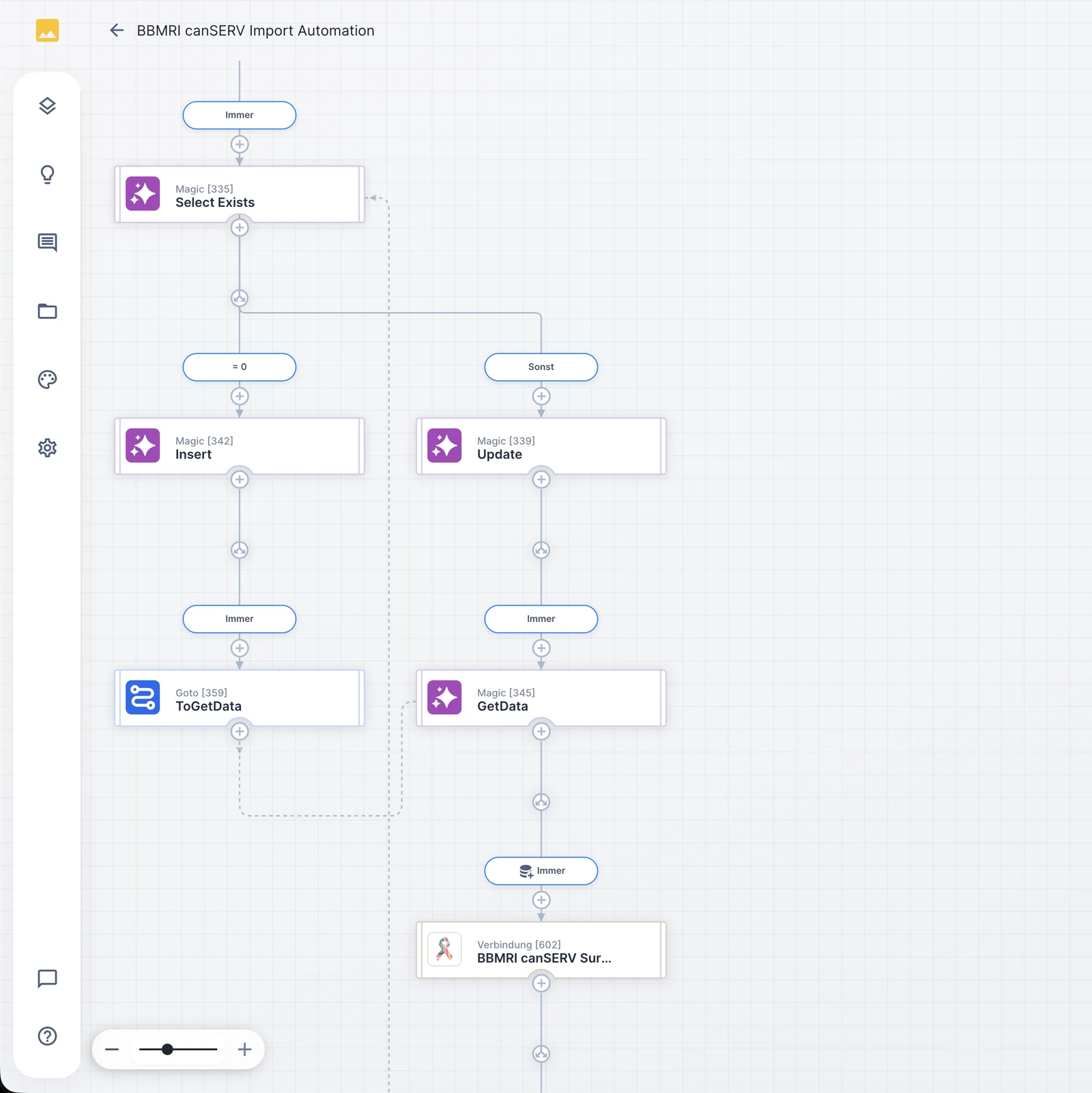
Ingest service data and send survey
The first, fully automated workflow reads data on new and already completed canSERV services from an existing directory. For each completed matter it then sends an email under the canSERV label, with a survey to the user and to the service provider. No manual look-up, no individual outreach.
Interactive
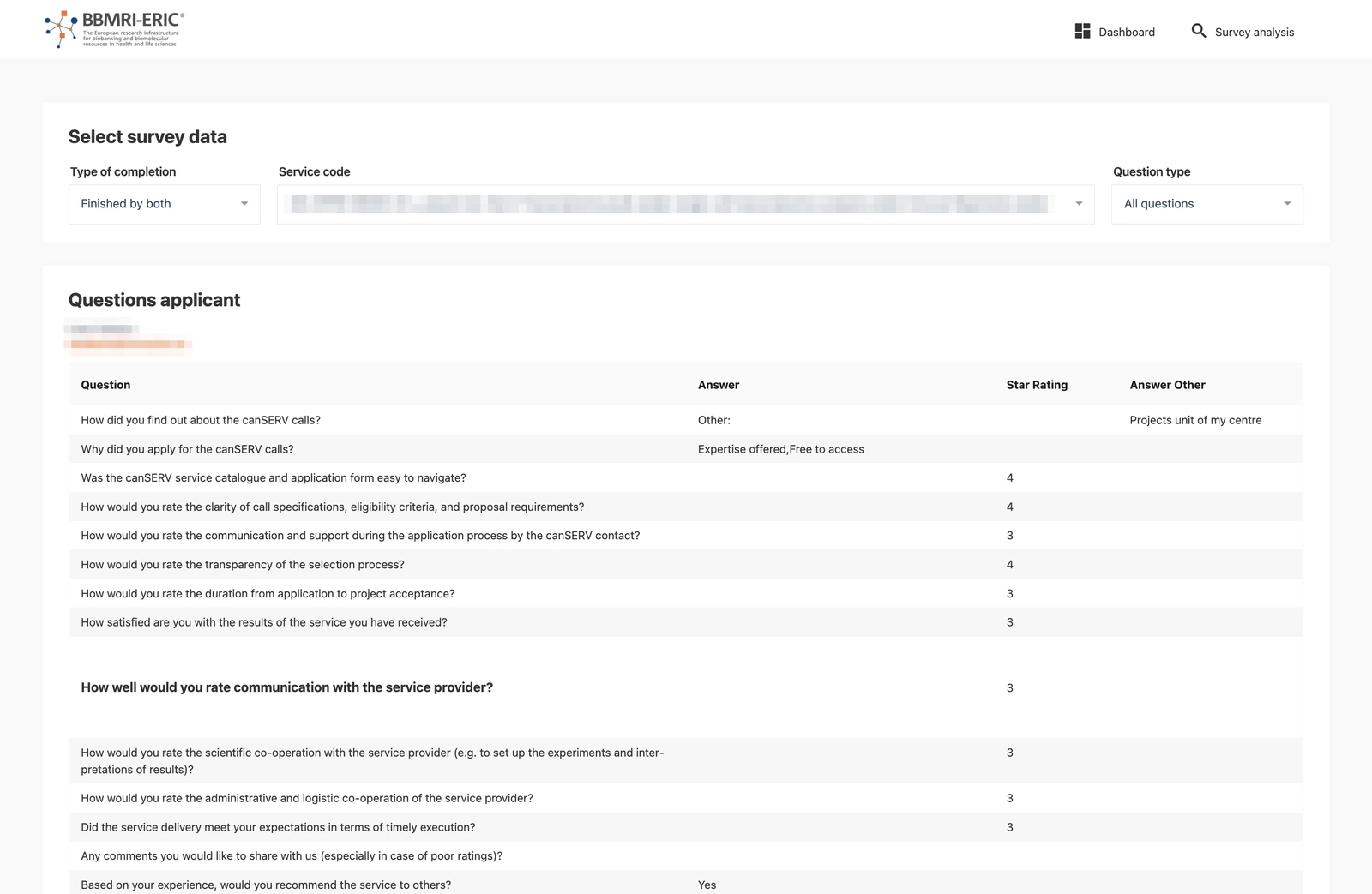
Tailored survey for both parties
The second, interactive workflow gives users and service providers a survey tailored to their respective role. Both assess the quality of the other party and the flow of the entire process. Responses are processed and stored in a structured way in a database, as the basis for subsequent analysis to drive quality improvement.
Interactive
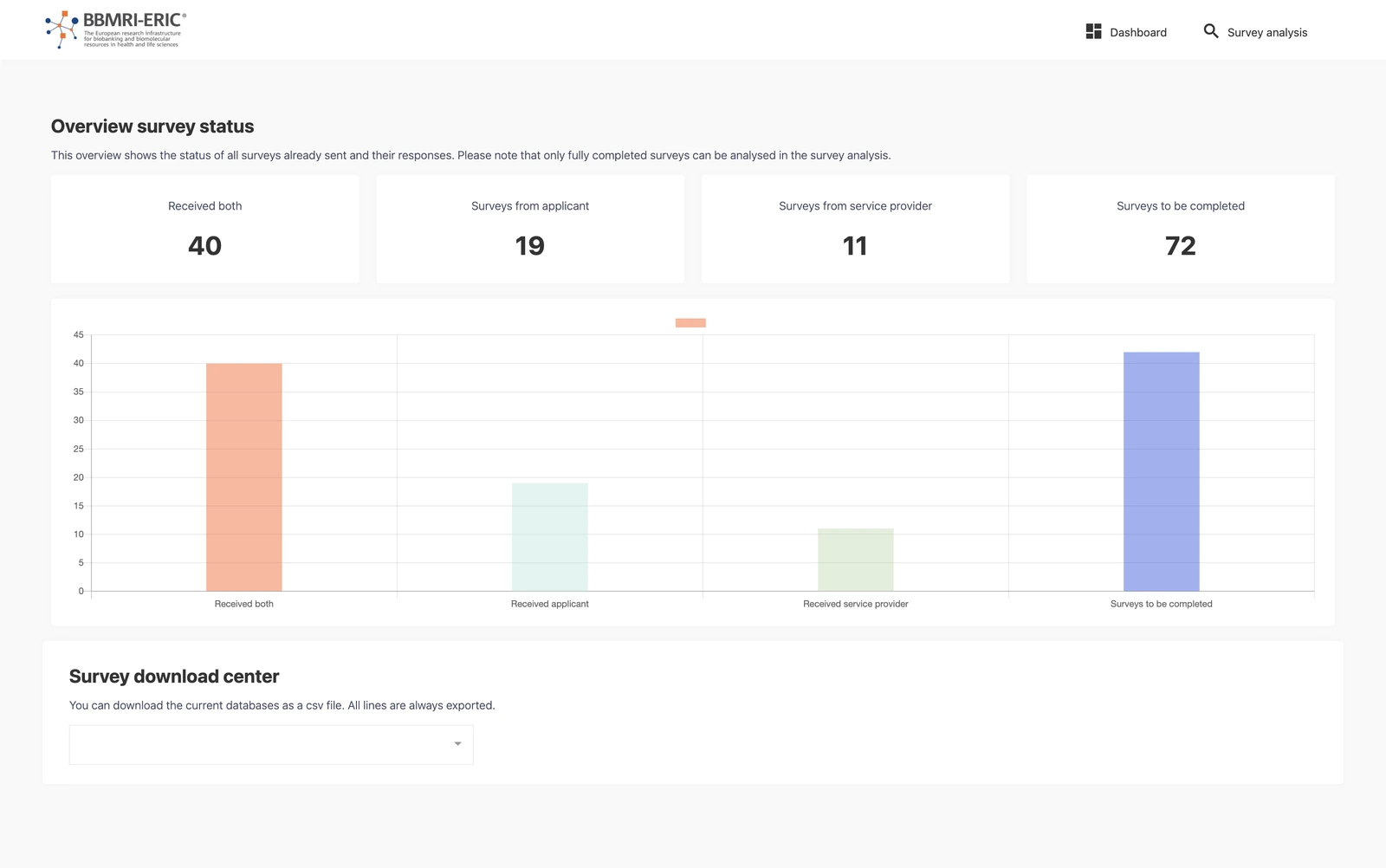
Quality dashboard for the QA team
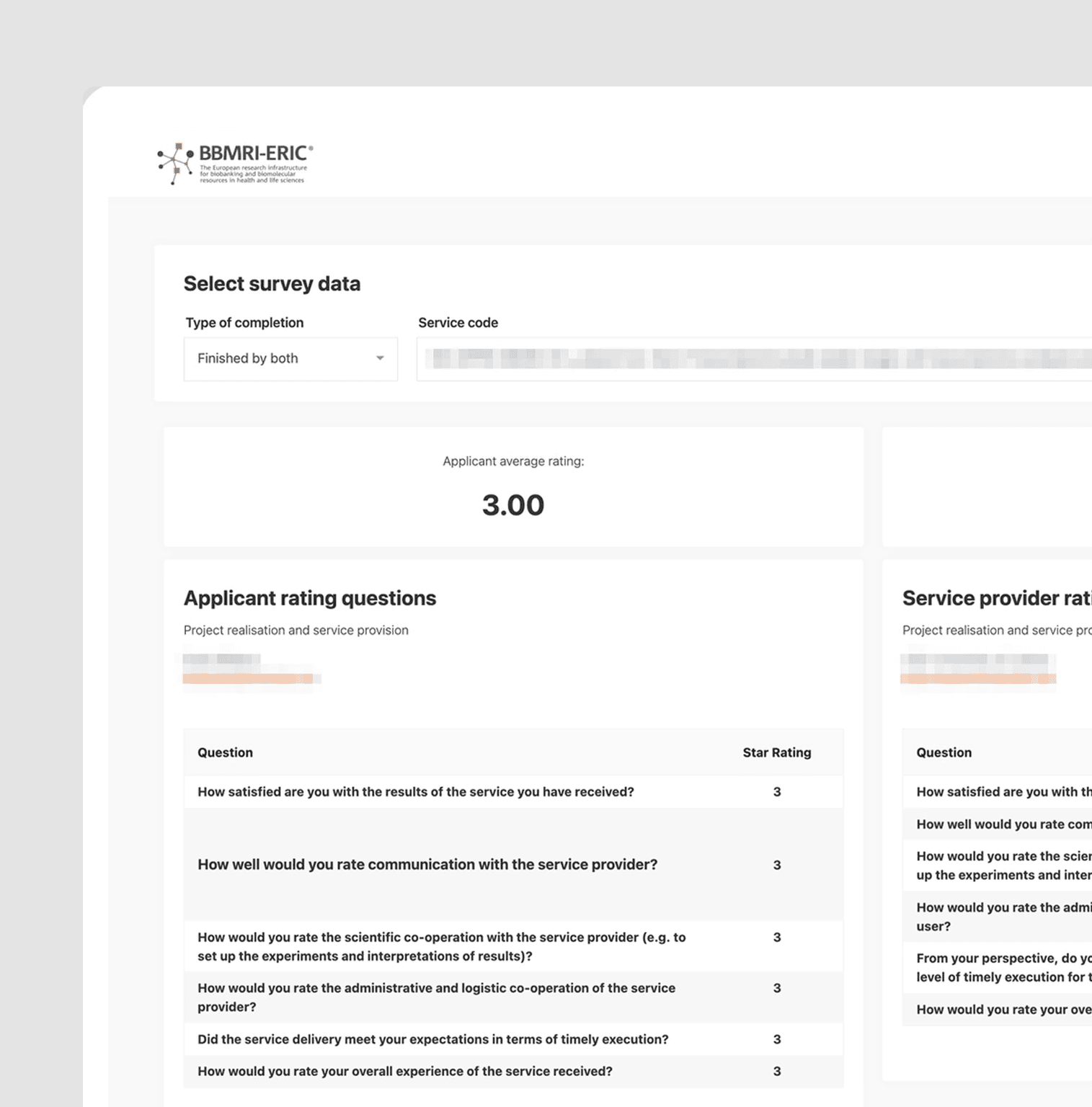
The third, also interactive workflow presents the processed data as a detailed dashboard. The BBMRI-ERIC quality team can see which service processes worked well and where improvement is needed, ensuring that both users and service providers receive the highest possible quality in future.
Results
What has changed.
interlocking workflows in use
perspectives per service: user & service provider
manual dispatch of feedback requests
QA team focused on improvement rather than chasing responses
Frequently Asked
What you should know about this case.
Who builds the workflows for canSERV?
BBMRI-ERIC and the UNOY team together, co-build model. The BBMRI QA team knows the canSERV services, the parties involved, and the quality criteria. UNOY brings the platform and technical know-how. After the build phase, BBMRI-ERIC operates the three workflows independently and adapts surveys and analysis as needed.
What data is stored on UNOY?
Only what is necessary for the feedback loop: the master data of completed canSERV services, contact details of user and service provider, email templates, and survey responses for later analysis. No biological sample data, no patient data. Scientific data and service results remain with the respective institutions.
What does the feedback loop look like in practice?
Three workflows: Workflow 1 automatically ingests completed canSERV services and sends the survey under the canSERV label to user and service provider. Workflow 2 collects, via a role-specific survey for each party, the assessment of the counterpart and the process, and stores responses in a structured way. Workflow 3 presents the processed data as a dashboard for the QA team.
Does this meet the GDPR requirements of a research infrastructure?
Yes. Contact and survey data are processed in EU data centres. Data residency is GDPR-compliant, no transfers to third countries without explicit authorisation. Audit trail for every processing operation. Contracts under EU standard contractual clauses where required.
What happens if BBMRI-ERIC later switches platform or provider?
Workflow definitions are available as a versioned export (JSON + Markdown). Service master data and survey responses can be extracted in a structured way. Audit trails are documented as an append-only log and are exportable. No lock-in effects beyond the current co-build agreement.
Can this be applied to other service portfolios or projects?
Yes. The pattern of automatically collecting, structuring, and analysing bilateral feedback after every collaboration appears in almost every research infrastructure, funding project, and service organisation. Dispatch logic, role-specific surveys, and the dashboard can be adapted to the respective service portfolio.
Tech Stack
What runs under the hood.
Workflow Engine
Defines the three interlocking workflows, ingestion & dispatch, survey, analysis, as a versioned process.
Automated dispatch under canSERV label
Completed services are automatically ingested; the survey email is sent under the canSERV label to both parties. Templates can be adapted by BBMRI itself.
Role-specific surveys
Users and service providers each receive a survey tailored to their role, covering the counterpart and the process flow.
Database & quality dashboard
Survey responses are stored in a structured way and prepared as a dashboard, analysable by service and role for reporting and improvements.
Audit Trail
Append-only log of every ingested service, every sent survey, and every received response. Exportable for compliance.
EU data residency
Service master data, contact data, and survey data remain in EU data centres. GDPR-compliant, no transfers to third countries without explicit authorisation.
ISO/IEC 42001, AI Management
AI management standard the data centres are certified to — for regulated research environments. Complements ISO 27001 + SOC 2 Type II.
Integration with existing systems
Import via Excel to ingest the existing service directory. Responses land in a structured way in the analysis database.
Other Customers
More customer cases.

WKO Austria
Eight advisory applications for nearly 600,000 members.

FairPlane
100,000 passenger rights claims assessed under control.

PwC Austria
Compliance workflows that consultants build themselves.
Do you have a similar feedback or quality challenge? Let us deliver.
30 minutes. Your matter. One concrete recommendation.